
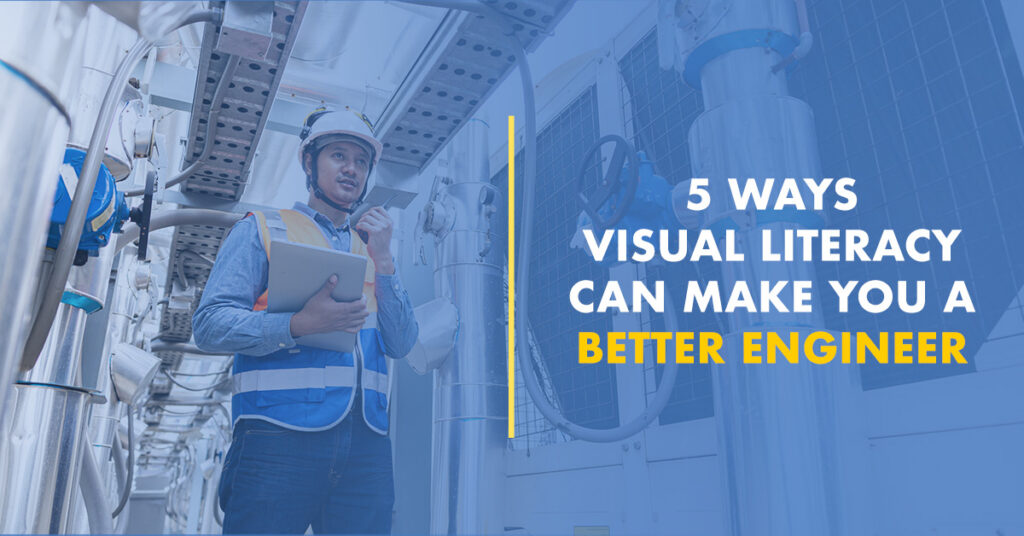
Visual Literacy in EHS can make you a better engineer because it sharpens how you see, interpret, and act on information in complex environments – especially where potential risk is involved.
1. Engineering Requires More Than Technical Knowledge
First, engineering is fundamentally about understanding systems: how parts interact, where stresses concentrate, and where failures might occur. Visual Literacy enhances your competency in accurately observing, interpreting, and communicating visual information. In EHS contexts, that means learning how to ‘read’ a workplace the way you would read a technical drawing.
Instead of just glancing at a scene or image, you pause to notice patterns, anomalies, and early warning signs. This shift from casual looking to disciplined seeing helps you catch hazards before they become incidents.
2. Improving Hazard Recognition and Risk Awareness
Second, Visual Literacy improves hazard recognition. Many EHS issues are visible long before they are formally recorded, e.g., a missing guard, an unusual stain that suggests a potential leak, a distorted shape that indicates deformation, a worker taking an awkward shortcut around a barrier.
Engineers who are visually literate learn to break images down into elements, like foreground, background, lines, colors, and shapes – and ask themselves:
- What looks different?
- What doesn’t belong here?
- What has changed since the last time I saw this?
This systemic method of observing increases the likelihood that you’ll identify risks in designs, prototypes, and field conditions. Over time, it trains you to think in terms of leading indicators rather than waiting for accidents and near misses to occur.
3. Designing Safer and More Intuitive Systems
Third, Visual Literacy strengthens your design work. EHS is not only about personal protective equipment and procedures. It should also be embedded into the design itself.
Engineers who are visually aware are more likely to consider things like line-of-sight, user interaction, and visual cues when designing equipment, layouts, and interfaces. For example, you might:
- Use color coding to distinguish higher-risk areas
- Arrange controls to visually guide correct operation
- Design layouts that minimize clutter and confusion during emergencies
Being able to better anticipate how people actually see and interpret their environment helps you produce safer, more intuitive systems and designs.
4. Communicating More Effectively Across Teams
Fourth, Visual Literacy enhances communication with both technical and non-technical stakeholders. Engineers frequently use drawings, diagrams, models, and dashboards to explain concepts. If you understand how people visually process information, you can create:
- Clearer schematics
- More intuitive process flow diagrams
- More effective safety signage
This leads to better understanding during design reviews, toolbox talks, risk assessments, and incident investigations. When EHS information is more visually clear, workers are more likely to comprehend and follow it, and management is more likely to support needed changes.
5. Building a Stronger EHS Mindset
Finally, practicing Visual Literacy helps build an EHS mindset. It encourages curiosity and reflection:
- Why did I notice that hazard only after the incident?
- What visual clues might have been available that I ignored?
This self-questioning pushes you to refine your observation habits, reduce assumptions, and become more present in the field. As you progress in your career, that mindset translates into leadership.
You become the engineer who not only solves technical problems, but also champions a culture where people pay attention, speak up about what they see, and continuously improve their environment.
Final Thoughts
In summary, Visual Literacy in EHS makes you a better engineer by helping you:
- See more clearly
- Detect potential risk earlier
- Design more safely
- Communicate more effectively
- Think more critically about the environments you influence
In a profession where small details can have significant consequences, strengthening how you observe and interpret the world around you can become a powerful advantage.