
Data Center Landscape
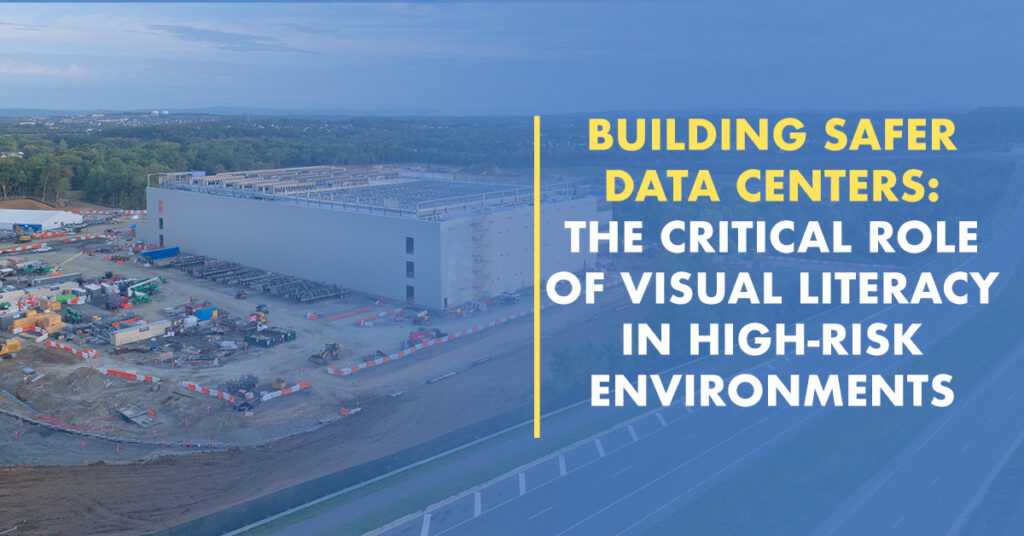
The rapid growth in demand for cloud computing and AI has resulted in a surge of data center construction in order to meet this demand. A recent study by McKinsey & Company projects that by 2030, companies will invest almost $7 trillion in capital expenditures on data center infrastructure globally with more than 40 percent of this spending occurring in the United States.
While significant challenges do exist in infrastructure needs as well as some community pushbacks for data centers in their local areas, the need is real and will need to be satisfied in one way or another. This rapid increase in construction activity also will result in higher demand for leaders, workers and safety professionals supporting these resource needs. Building skills in visual literacy will increase effectiveness in critical thinking, problem solving and communication that will enable successful project completion in a safe and efficient manner.
What Makes Data Center Projects Unique?
Construction projects have existed for a long period of time and each presents their unique challenges. The experience in building manufacturing and distribution facilities over time have resulted in a good understanding of what is required to safely complete a project using safety management systems and leveraging best practices from earlier successful projects.
The explosion in data center projects may lack this experience and is further complicated by a number of factors that represent higher risk in completing these projects without incident or injury. Headwinds exist because of critical shortages of skilled professionals across nearly all disciplines. A large data center is complex from start to finish and may involve thousands of construction workers to prepare the site and build the facility along with the supporting infrastructure.
The following can make a data center project different from other projects and introduces risk that must be managed in order to achieve our safety objectives.
1
Time Pressure – the growth in cloud computing and AI has resulted in an unprecedented demand for data center capacity, and providers are moving at a rapid pace to increase capacity, often working 24×7 on job sites to complete projects on or ahead of schedule.
2
High Density Power Loads – Data centers require significant electrical power to support servers and cooling systems. The risk of electrical hazards, such as overloads and short circuits, is higher, necessitating stringent safety measures during installation.
3
Cable Management – Data centers require extensive cabling for power and data transmission. Poor cable management can lead to tripping hazards and can complicate emergency evacuation scenarios.
4
Cooling System Complexity – The cooling infrastructure is often complex, involving chillers, cooling towers, and air handling units. Ensuring the safe installation and maintenance of these systems is critical to prevent overheating and related hazards.
5
Equipment Handling and Protection – The construction involves heavy machinery and equipment, which can pose safety risks to workers. In addition, the handling of electronic equipment which is sensitive to contamination and damage places additional pressure on construction and installation processes.
6
Commissioning Process – The commissioning process for data centers is extremely detail oriented and includes certified inspections, testing and third party approvals before operations. The quality of equipment, reliability, security and general operations is critical for data centers for their support of the many users and data that is processed.
How can Visual Literacy help make these projects safer and error free?
Being proactive in managing risk begins with seeing the hazards that are present and taking action to mitigate them. If we don’t see the hazards, we have no ability to do anything about them. The same is true with potential quality issues resulting from errors in construction and equipment installation. This results in incidents occurring that may cause the loss of valuable time and resources.
Construction may slow because critical employees and their skills are not available as they recover from injuries. Equipment failures may occur when abnormalities are not seen and resolved so construction time is not lost. Errors may occur during equipment installation because conditions are not seen that prevent safe and effective completion.
The likelihood of these incidents occurring can be reduced by applying tools and techniques that improve our ability to see details that are right in front of us that may indicate the presence of hazards or abnormal conditions that may result in injuries or errors in the construction process.
Visual Literacy is all about what we see, what it means, and the action we take.
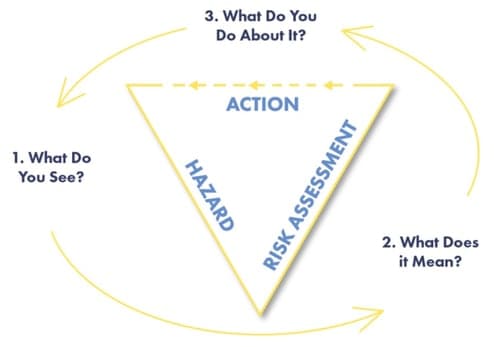
Developing Visual Literacy competencies in our people can help organizations reduce incidents and save valuable resources and time. This is especially beneficial to projects such as data centers where speed in completion is especially important in timely delivery of computing capacity to support the rapid growth of cloud computing and AI. Improved observation skills will help leaders manage risk in all areas of the project including adherence to design and tactical execution.
Visual Literacy skills can positively impact all areas from original design through project completion. Construction contractors are focused on schedule and budget while performing the job safely, in an environmentally friendly manner. The site usually has multiple contractors, some working simultaneously performing high risk tasks. Having project leaders and safety people with the proper systems and skills is imperative to a successful project. Sharing best practices and lessons learned through the Visual Literacy lens using systems to support this type of high risk fast paced work can give contractors a competitive edge. Many safety and leader capabilities programs take a long time to implement and sustain. COVE has developed a training system that is quick to implement, immediately applicable to this work, and is sustainable with leadership support.
The return on Visual Literacy investment.
The investment in Visual Literacy is a training investment in people. Training is essentially experiential learning in a workshop format that teaches tools and techniques that build Visual Literacy skills. These skills are a set of structured and disciplined approaches to seeing the reality of the environment around us, much as an art historian looks at a work of art in order to interpret what story the artist is telling. The same tools that accomplish this for an art historian can also be used by workers on a job site to identify hazards and other abnormal conditions.
One of the most effective engagement methods is investing in our people in building capabilities that make them more effective on the job and in their personal lives as well. Visual Literacy is one of those capabilities. This can result in attracting and retaining the resources most valuable to successful project completion – our people.
The benefit? Beyond the simple moral commitment to a safe working environment, there are real costs to incidents and errors that occur. The cost of an injury varies wildly because the range of outcomes of an injury is extremely broad based on severity and the type of injury involved. A minor injury might cost in the hundreds of dollars with little lost time involved while a more serious injury or fatality can stretch into the hundreds of thousands if not millions of dollars. While a single, non-fatal lost-time injury might have a direct (insured) cost of $42,000, the total, real cost to the company—once indirect costs are included—is more likely to be in the range of $126,000 to $420,000. The cost of a fatality can average $1.39 million or more.
When we think about project delays because of injuries or error driven delays, the costs can be even larger. According to research by the Construction Industry Institute, a typical project delay is between 20-30%. For a $50 million project with a 3-year schedule, the “value” of each day is approximately $45,662. In that context, a delay of just one week—whether from fixing an error or from a lost-time injury—could cost the project over $300,000 in lost value, labor, and overhead.
The return on a typical investment in Visual Literacy training is paid back almost immediately by the elimination of one injury or one delay.
Conclusion
The need for increased data center capacity has never been greater, driven primarily by cloud computing and AI. Data center investment (construction and equipment) is projected to grow an average of 25% per year for the next several years in order to meet this demand. Extreme time pressure to complete these projects and unique risks associated with data center construction and equipment installation increases the overall risk of injuries and project delays. Training in Visual Literacy can provide workers with a competency that helps them see hazards and potential errors proactively and mitigate them before incidents and delays occur.